St Werburgh's Catholic Parish, Chester
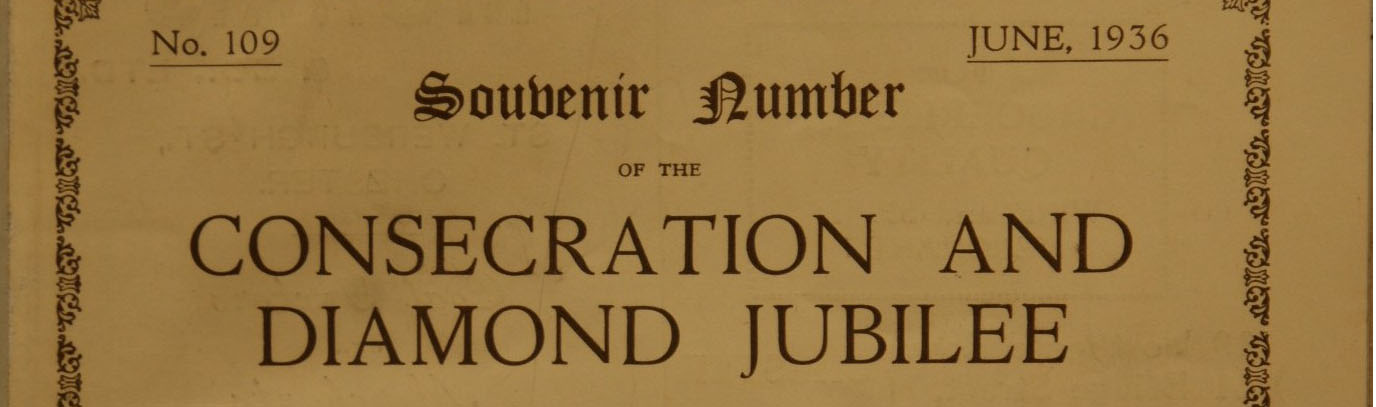
The Parish Magazine for June 1936 was a souvenir issue to mark the consecration of the Church on 31 May 1936, and to reflect on its Diamond Jubilee with a series of articles describing the ceremony of Consecration, the history of the Parish, the history of St Werburgh and her shrine, and a number of aspects of the contemporary Parish life. The text below reproduces the full content of the issue. A PDF copy may be downloaded by clicking on the cover image.
THE CONSECRATION OF ST WERBURGH'S
"O Lord, bless this house which I have built unto Thy Name. Whosoever shall come unto this place and pray, then hear Thou from the excellent throne of Thy Glory. Alleluia."
![[Parish Magazine cover]](/media/yloj4l0u/magazine_cover.jpg?rmode=max&width=350&height=472)
HYMN
CHRIST is made the sure Foundation,
And the precious Corner-Stone,
Who, the two walls underlying,
Bound in each, binds both in one:
Holy Zion's Help for ever,
And her Confidence alone.
All that dedicated City
Dearly loved by God on high,
In exultant jubilation
Pours perpetual melody;
God the One, and God the Trinal,
Singing everlastingly.
To this Temple, where we call Thee,
Come, O Lord of Hosts, to‑day!
With Thy wonted loving kindness
Hear Thy people as they pray;
And Thy fullest benediction
Shed within its walls for aye.
Here vouchsafe to all Thy servants
That they supplicate to gain;
Here to have and hold for ever
Those good things their prayers obtain;
And hereafter in Thy glory,
With Thy blessed ones to reign.
Praise and honour to the Father;
Praise and honour to the Son;
Praise and honour to the Spirit;
Ever Three and ever One:
Consubstantial, co‑eternal,
While unending ages run. Amen.
THE CONSECRATION OF A CHURCH
By a decree of the Council of Trent (Sess. xxii.), Mass should not be celebrated in any place except a consecrated or blessed church. Hence it is the wish of the Church that at least cathedrals and parish churches be blessed (Cong. Sac. Rit., 1875); but any church and public or semi‑public oratory may be consecrated (Con. Rit., 1899). Both by consecration and by blessing a church is dedicated to Divine worship, which forbids its use for common or profane purposes. Consecration is a rite reserved to a bishop, who by the solemn anointing with holy chrism, and in the prescribed form, dedicates a building to the service of God, removing it "in perpetuum" to a higher order, removing it from the malign influence of Satan, and rendering it a place in which the prayers of the faithful are more readily heard and favours are more graciously granted by God (Pontificale). The blessing of a church is a less solemn rite, which may be performed by a priest delegated by the diocesan bishop. It consists in the sprinkling with holy water and the recital of prayers, thus making it a sacred place, though not necessarily "in perpetuum". Consecration differs from mere blessing in this, that it imprints an indelible mark on the building, by reason of which it may never be transferred to common or profane uses. On the evening preceding the day of the consecration, the consecrating bishop places in a reliquary the relics of the martyrs which are to be placed in the altar, three grains of incense, and an attestation written on parchment. The Cong. Sac. Rit., 16th February 1906, declared that for the "valid" consecration it suffices to have enclosed the relics of one martyr. The reliquary is then placed in an urn or in the tabernacle of an altar in a nearby church or oratory, or in an adjacent room or sacristy. At least two candles are kept burning before these relics during the night, and Matins and Lauds "de communi plurimorum martyrum," or of the proper office of the martyrs whose relics have been placed in the reliquary, are sung or recited. At the beginning of the consecrations on the next day the candles under the crosses on the walls are lighted. After this the bishop and the clergy go to the place in which the relics of the martyrs were deposited the evening before, the church meanwhile being left in charge of a deacon. Whilst the bishop is being vested the seven Penitential Psalms are recited, after which all proceed to the main entrance of the church, where, remaining outside, the bishop blesses the water. The bishop then goes three times round the outside of the church, the first time sprinkling the upper part of the walls, the second time the lower part, and the third time on a level with his face. After each circuit the bishop strikes the door with the base of his crosier and says: "Lift up your gates, ye princes, and be ye lifted up, ye everlasting doors, and the King of Glory shall come in." Three times the deacon within the church asks, "Who is the King of Glory?" Twice the bishop answers, "The Lord of Armies, He is the King of Glory." This triple sprinkling and the circuit of the walls, symbolizes the triple immersion at holy baptism, the consecration of the soul as the spiritual temple of God, to which the material bears a certain analogy.
The bishop and his attendants now enter the church, leaving the clergy and people outside, and the door is closed. The Chanters sing the "Veni Creator Spiritus" and chant or recite the Litany of the Saints. After this, whilst the canticle "Benedictus" is being chanted, the bishop traces with the point of his crosier, in the ashes spread on the floor, first, the Greek alphabet, beginning at the left side of the church door and proceeding to the Epistle corner of the church near the altar, then the Latin alphabet, beginning at the right side of the church door and proceeding to the Gospel corner of the church near the altar. The "Liber Sacramentorum" of St. Gregory I., and the "Pontificale" of Egbert, Archbishop of York, attest the antiquity of this ceremony, which symbolizes the instruction given to the newly baptized in the elements of faith and piety. The crossing of the two lines points to the Cross, that is, Christ crucified, as the principal dogma of the Christian Religion. The Greek and Latin languages represent the Jews and Gentiles respectively. The Greek alphabet is written first because the Jews were first called to the Christian Faith. The bishop then blesses the Gregorian water, a mixture of water, salt, ashes and wine, prescribed by St. Gregory I. to be used at the consecration of a church. After this he goes to the main door of the church, and with the crosier traces a cross on the upper part and another on the lower part of the door inside. The ingredients of this water are to recall to our mind the legal purifications and the sacrifices of the Jewish people, the wine taking the place of the blood. The symbolism of this mixture is explained by authors in various ways. The cross traced on the door is to be, as it were, a guard lest the work of redemption in the church be thwarted by malignant influence from without. The bishop now traces with Gregorian water five crosses on the altar, and then sprinkles the support and table on the altar seven times, passing round it seven times, whilst the chanters sing or recite the Psalm "Miserere." He then sprinkles the walls in the interior of the church three times, first the lower part, then on a level with his face, and lastly the upper part, after which he sprinkles the floor of the church in the form of a cross, passing from the altar to the door, and from the Gospel to the Epistle side in the middle of the church. Having returned to the middle of the church, he sprinkles with one swing each time the floor before him, behind him, at his left and at his right.
The bishop, clergy and laity then go to the place in which the relics repose, and in solemn procession carry them to the church. Before entering, the relics are borne round the outside of the church, whilst the clergy and people repeat "Lord, have mercy on us." Having returned to the church door, the bishop gives a suitable exhortation to the people and addresses the founder of the church. Then one of the clergy reads the two decrees of the Council of Trent from the Pontifical. The bishop next anoints with holy chrism, three times, the pillar on each side of the door, after which the clergy and laity enter the church, and the consecration of the altar takes place. Finally, the twelve crosses on the interior walls are anointed with holy chrism and incensed by the bishop; the altar cloths, vases and ornament of the church and altar are blessed, and solemn or low Mass is celebrated by the bishop. If he be too fatigued he may appoint a priest to celebrate in his stead. At the end of the Mass an Indulgence of one year is published, which may be gained by all who visit the church on the day of the consecration. At the same time another Indulgence which may be gained in the same manner on the anniversary of the consecration is published. If the latter Indulgence is granted by a cardinal in his titular church or in his diocese, it may be of 200 days; if by a bishop, of fifty days, in their respective diocese.
CONSECRATION & DIAMOND JUBILEE OF ST. WERBURGH’S CHURCH
When the writer of this notice came to Chester 37 years ago, the Shell of St. Werburgh’s stood bare and gaunt and bleak against what was then Grosvenor Park Road. Union Street was a mud road, if road it might be called. Where the Chester Corporation Baths now stand was the part of a disused tanyard, with an old house at the end. The present Bath Street was a series of Courts within Courts, a vile and horrible place where the poor existed during the week, and on Saturday nights knifed their fellows in the Courts and in Union Street, leaving the few clergy of St. Werburgh’s to spend sleepless week‑ends, and compelling a Bishop of Shrewsbury to declare, on the occasion of a Visitation to St. Werburgh’s, that "never had his ears drunk viler language." This was the Most Rev. Dr. Knight, a former Bishop of Shrewsbury. Canon Lynch and Canon Chambers, both passed to their reward, were the two builders of St. Werburgh’s Church. Canon Lynch for many years worked away to pay the debt on the first half of the Church. Canon Chambers saw the foundation of the second half of the Church laid. He also had built the present beautiful Sacristies, he saw the Memorial Chapel to St. Werburgh’s Men, who were killed in the Great War, erected by subscriptions from the people. He enlarged St. Werburgh’s Boys’ School at a cost of thousands of pounds, to accommodate the boys of St. Francis’ Parish, when the grant was withdrawn by the Government from St. Francis School. He struggled to pay the interest, unaided and alone. He saw the present Church completed. The writer of these notes was his Curate for 16 years and more, and knew him and loved him as a perfect English Gentleman, an ideal Rector, hospitable and most kind, and devoted to the people of the Parish; a perfect priest and the soul of an English Gentleman. The Sacred Heart Chapel, Altar and Stained‑glass Window were given by Miss Josephine Hall, in memory of her parents, deceased (R.I.P.). The present High Altar and Altar Rails were erected from money left by Canon Chambers (R.I.P.) and Miss Margaret Collins (R.I.P.). On the return of the writer of this article to Chester he had erected the oak-panelling round the Church and the redoing of the walls of the Aisles in Cotastone, by Brown's of Chester, at a cost of £1,000. Later the Shrine to St. Werburgh, to the design of Mr. E. B. Kerby [sic], by Messrs. Johnstone Jones of Liverpool. Statues of the Saints in carved wood, by the Art and Book Co., London. Later the Sanctuary was panelled by Messrs. Pritchard of Chester, to the design of Mr. E. B. Kirby, Liverpool. Later, the great Rood was hung at the entrance to the Sanctuary (figure 7 feet), all carved wood, to the design of Mr. E. B. Kirby, Architect. Cross by Johnston Jones, Liverpool; the Figure by the Art and Book Co., London. Later the Sanctuary walls and roof were decorated by Brown's of Chester, to the design of Mr. E. B. Kirby, and the Angels supporting the Sanctuary Pillars were decorated by Miss Trina [sic] Cox of Chester Studios, who also designed and executed the Stained‑glass Window to St. Christopher, in the Porch of the Church. To the memory of Miss Humphries, twelve Stained‑glass Rosary Windows have been given by Parishioners, at a cost of £75 each, to the present Parish Priest, and have been set and made by Messrs. Hardman’s of Birmingham; thus completing the whole set of Rosary Windows in the Church.
Last, but not least, in preparation for the Consecration there has been placed in the Sanctuary the new Parquetry Floor and Stalls, costing nearly £800, given by the faithful people of St. Werburgh’s Parish, made by Messrs. Johnston Jones of Liverpool, to the design of Mr. E. B. Kirby, Architect. At this great and glorious time of the Consecration of the Church of Our Holy Mother, St. Werburgh, on the Banks of Ancient Deva, we mention with reverence and gratitude the Bishops of the Diocese who had a share in the glory of St. Werburgh’s, and ask the prayers of the Catholic Chestonians for their Eternal Rest.
The Right Rev. Dr. Brown, D.D., Bishop of Shrewsbury.
The Right Rev. Dr. Knight, D.D., Bishop of Shrewsbury.
The Right Rev. Dr. Allen, D.D., Bishop of Shrewsbury.
The Right Rev. Dr. Singleton, D.D., Bishop of Shrewsbury.
Rectors -
Canon Dallow (for short time Rector). R.I.P.
Canon Lunch [sic]. R.I.P.
Canon Chambers. R.I.P.
Canon Rooney (two years Rector). R.I.P.
One time Curates -
The Very Rev. Canon O’Reilly (Sale).
The Very Rev. Canon Edgar Kirby (Seacombe).
Rev. Father Kirby (Altrincham).
Rev. Father D’Arcy (Ludlow).
Rev. Father Mulcahy (Sandbach).
Rev. Father Irish.
Rev. Father Worsley.
Rev. Father Donnelly.
Rev. Father Campbell.
Since the return of the writer of these notes to Chester the debt on the Schools has been reduced from £7,000 to £700. All improvements in and decorations to the Church and Sanctuary have been paid for, and the Church made ready for Consecration — thanks to the faithful, loyal and generous people of St. Werburgh’s Parish and to friends far and near.
We feel on this great occasion we ought to mention names of out-standing Benefactors, living and dead, and ask the prayers of our people and children of the Parish for all of them -
Miss Josephine Hall and deceased relatives.
The Tatlock Family, R.I.P.
Mr. and Mrs. George Hostage and the Hostage Family.
Mr. H. V. Leigh. R.I.P.
The Collins Family. R.I.P.
Mr. and Mrs. Cotgreave. R.I.P.
Mr. Hugh Flood. R.I.P.
Mr. George Seddon. R.I.P.
Miss Georgina Broe. R.I.P.
Mr. and Mrs. William Evans. R.I.P.
Colonel and Mrs. Hemelryk.
Mr. and Mrs. Peet (Kingsley-Frodsham).
Miss Katie Rose (in Memory of Parents. R.I.P.).
Mr. Ed. and Jos. Evans.
Mrs. Fitzsimons, Mulee, Owen. R.I.P.
Mr. J. McGeever (First President of C.Y.M.S.). R.I.P.
Alderman Gibbons, J.P. R.I.P.
Mr. and Mrs. Talbot.
The Women’s Confraternity (U.C.M.).
The C.Y.M.S.
The C. of M.
The S.V.P.
The K.S.C.
And all the Donors of the Consecration Crosses, whose names have been given in a previous issue of the Magazine (and to whom many thanks).
We hope to have St. Werburgh’s Flood‑lit, without and within, on Whit‑Sunday, May 31, the Day of the Celebration of the Consecration and Diamond Jubilee, from 9.45 to 11 p.m. We ask all the people of St. Werburgh’s, who have never yet failed us, to stand by us and around us on this great and glorious occasion of the Diamond Jubilee of the Church of Our Holy Mother and Patroness, St. Werburgh, who still watches over Ancient Deva and St. Werburgh’s, and the people who on the banks of the Dee dwell.
CANON HAYES.
FR. LOWERY.
FR. MCGINLEY.
FR. MURPHY, B.A.
P.S. — We would add this note of most sincere thanks to Mr. and Mrs. Talbot for all the work they have done for St. Werburgh’s, looking for no reward but that which comes from God. They have brought hundreds of pounds to St. Werburgh's, and we commend their good estate to the prayers of the people.
FR HAYES.
HISTORY OF ST. WERBURGH'S CHURCH, CHESTER.
This is the Mother Church of the City, and by far the larger Parish. The Registers date back to 1794, but it is clear that a priest served the District before that time. There is some doubt whether Mass was said in a room situated in Parry’s Entry, off Foregate Street and since demolished, or in Love’s Lane. The Rev. Thomas Penswick, who afterwards became Vicar Apostolic of the Northern District, served the Mission from 1796, and between that year and 1802 he succeeded in raising funds for the building of a Church (now the Girls’ School) and Presbytery in Queen Street. About 1854 a school was erected at the rear of Queen Street buildings. This school was utilised until the passing of the Elementary Education Act, 1870, rendered additional accommodation necessary, and new schools were then built by the then Rector, Canon Buquet. About this time, thanks largely to the generosity of a Catholic Family, the site of the present Church was purchased. The foundation stone of this edifice was laid in 1873 by the Bishop of the Diocese, and the first Mass was said on Christmas Day, 1875, the Church being solemnly opened in July 1876. The Presbytery was also built by the generosity of the family referred to above.
The Church stood unfinished for many years, but the completion was effected in 1913 by the then Rector, Canon Chambers, and the beautiful front portion of the Church facing Grosvenor Park Road was opened in 1914, just before the outbreak of the European War. Prior to this, Canon Chambers had been obliged to incur a very heavy debt in connection with the extension of the Schools.
The Mission has been served by some distinguished Clerics in the course of its history, as, in addition to the Rev. Thomas Penswick mentioned above, the Rev. John Briggs, afterwards Vicar Apostolic of the Northern District, and Bishop of Beverley, was stationed here 1818 to 1833.
A notable convert, Canon Cholmondeley, a member of the well‑known Cholmondeley family, was attached to the Staff for about 20 years prior to 1872.
ST. WERBURGH AND HER SHRINE
St. Werburgh was a most distinguished lady in Mercia in the seventh century, being born in the part of the "Midlands" now called Staffordshire, at the town of Stone. She was the daughter of King Wulfere, her Grandmother (St. Erminilda), her Mother (St. Sexburga), and her Aunt (St. Etheldreda), were all illustrious for their beauty and virtues. When very young she entered the famous Convent of Ely, which enjoyed the unique privilege of having for its first three Abbesses of the Order of St. Benedict the aforesaid ladies, a Queen of Northumbria, a Queen of Kent, and a Queen of Mercia.
Allured by her many attractions of mind and body, a rough Saxon noble, called Werbode, sought her hand in marriage, but to his disgust Werburgh could not be moved from her holy intention of entering the cloister. Her father also threw in his influence to force upon his daughter so suitable a match, but all to no purpose. Imagining that her two brothers — Wulhad and Ruffin — who had been recently baptised by St. Chad (first Bishop of Lichfield), were upholding her in her design, the wicked suitor, by connivance of their own father, slew them both in a fit of passion. The great pile of stones, which, according to the custom of those days, was raised on the site of their martyrdom, gave the name of Stone to the town which sprang up there afterwards.
The King, now struck with remorse at his crimes, strenuously laboured to extirpate idolatry from his dominions, and by way of reparation built a Priory at Stone, and at Medehamsted, the modern Peterborough. The reception of St. Werburgh as a nun at the great Abbey of Ely was made an affair of great pomp. The Royal Maiden was escorted thither by her father and a large company of Saxon Nobles, and she was met at the gate by her Aunt, the Royal Abbess, St. Etheldreda, who had received the veil from St. Wilfrid, Bishop of York.
Here St. Werburgh put aside her jewels and rich apparel, and received the black, coarse habit of St. Benedict. She devoted herself straightway to a life of prayer and rigorous mortification. After the death of Wuldere in 675, Ethelred, her uncle, who succeeded the throne, implored of our Saint to leave the Abbey of Ely and take charge of all the religious houses in his kingdom of Mercia, that they might be brought by her pious influence, under one rule of exact discipline. St. Werburgh consented, and founded by his munificence the famous Convent of Trentham and Hanbury, in Staffordshire, and Weedon, in Northamptonshire.
Thus did St. Werburgh become the spiritual mother of innumerable virgins, yet so far was she from being elated by her dignity, that she never forgot her own religious duties. Her chroniclers tell us that she recited on her knees daily the entire Psalter of David, viz., 150 Psalms; that she remained in the Church from midnight Office till daybreak, bathed in tears, and that she allowed herself but one simple meal each day. After a life of good works she calmly foretold her own death, then made all preparations and gave final orders with the same regularity which had marked her whole career. She gave up her soul to God in her Abbey at Trentham on the 3rd of January, 692. The people of the neighbourhood, by a custom not uncommon in those days, fought for the possession of her body, but according to her dying wish it was buried at the Abbey of Heanburgh, or Hanbury. Nine years later, in 701, the body was taken up in the presence of King Kenred and many Bishops. It was incorrupt, and was now placed in a new and costly shrine.
In 875 the Danes were making encroachments in the neighbourhood, and therefore, for greater safety, her remains were solemnly conveyed to Chester, where Ethelred, son‑in‑law of Alfred the Great, rebuilt the Church of SS. Peter and Paul, and endowed the new edifice in honour of St. Werburgh (which became afterwards the Cathedral), placing there a College of secular Canons. In the reign of St. Edward the Confessor the Church was built in a yet more sumptuous manner, by Leofric and Godiva. Hugh Lupus, first Earl of Chester, removed the above Canons and placed instead Benedictine monks from the famous Abbey of Bec, in Normandy, over whom St. Anselm (the future Archbishop of Canterbury) appointed his own Chaplain, Richard, the first Abbot of Chester. The long line of Abbots continue unbroken to John Clarke, the 27th, when at the dissolution of religious houses by Henry VIII, the last Abbot became the first Dean. William of Bebbington (1345–9) was the first Abbot who sat in Parliament, a privilege enjoyed by a limited number only of Monasteries in the Kingdom.
We now come to speak of the Shrine of St. Werburgh. It is not known exactly when or by whom this shrine — or more correctly, the stone monument which held the shrine or casket, was erected. From its beauty and elaborate workmanship its date is placed in the reign of Edward II., when Gothic art was at its zenith. In the "Ages of Faith" men worked solely for God’s glory. This shrine was re‑erected by Dean Darby in 1889. About eight feet high, it consists of two storeys. The carvings and the statues are beautiful and delicate. We hope that all who can do so will visit the shrine itself and say a prayer for the return of the Ancient Faith to Chester, and England. Its original position is not certain. It is one of the very few shrines spared by the Huns of the Reformation.
When the Tudor Tyrant made the first Bishop of Chester, the stone shrine of the Patron Saint of the City became the Episcopal Throne, and from henceforth dates its various changes and mutilations. The bones of St. Werburgh probably shared the common fate on our English Saints, viz., they were either buried secretly by the Benedictine Monks, or if such precautions were neglected, they were cast out profanely, and the rich casket became the prey of the sacrilegious Henry.
In all England there are now only two Catholic Churches dedicated to her, namely, Chester and Birkenhead. Strangely enough an ancient church in Dublin, built by Chester immigrants in the middle ages, also bears her name. Let us hope that Catholic Pilgrims will come to her shrine, and implore her prayers for the final undoing of the Reformation.
As one of our last acts of gratitude before the Consecration of St. Werburgh’s, we have to record in this Jubilee Number of the Magazine the very great kindness and generosity of Miss Winifride Tallon, a retired member of the Staff of St. Werburgh’s Girls’ School, who has paid off the last remaining debt on the Church before its Consecration (£65), in memory of her deceased parents (Frank and Jesse Tallon). We hereby express our gratitude to Miss Tallon, and we ask the readers of this Number to pray for the good estate of the Donor and for the Eternal Rest of her parents (R.I.P.). After the Consecration, Masses will be offered for the parents of Miss Tallon, and also for Miss Dot. Fitzsimo [sic] (deceased member of the Staff of St. Werburgh’s Infants’ School), whose family have worked for and been most generous to St. Werburgh’s Church. A Tablet will be placed in the Sacristy recording the Gift of Miss Tallon.
THE CONSECRATION CROSSES
At this time of Consecration and Jubilee we must not forget those who so willingly and so generously have given, in a few days, the money for the Consecration Crosses. Mass will be offered for them and for their deceased relatives. We hereby give the list:- Miss Katie Rose, Mr. George Harrison, Mrs. M. Thorley Sykes, Mr. and Mrs. W. Talbot and Miss Ramsden, the the Mullee Family, Miss M. E. Rrynard (Boys' School), Major MacDermott, Miss Betty Dunne, Miss Cole, Mr. and Mrs. Peet (Frodsham), Mrs. Close and Miss Murray, the "Union of Catholic Mothers," and Anonymous.
We must not forget also the Schools of the Parish, the Teachers who therein have laboured and the generations of Children who have been educated within the Schools’ historic walls. The succeeding Rectors of the Parish have always been in the happiest relations with the Heads and Staffs of the School — Canon Lynch, Canon Chambers and Canon Hayes. The present Parish Priest remembers Mother Elizabeth, F.C.J. (R.I.P.), Mother Josephine, F.C.J. (R.I.P.), Mr. Philip Lane (now retired), Miss Georgina Broe (R.I.P.), Miss Dot. Fitzsimon (R.I.P.), Miss Lottie Jones (R.I.P.), Miss Ryan (R.I.P.).
Miss Maggie Fitzsimons, Miss Maud Raynard and Mrs. Dobbins, who have for years worked on the Staff. We pay our tribute to the present Heads and Staff of the School, Mothers Helen and Bernadette (Ursulines), Heads of the Girls’ and Infants’ Departments, Mr. J. Cunningham (Headmaster of the Boys’ Department), and to Miss Raynard, Mrs. Dobbins, Miss Quaid, Miss Kyne, the Senior members of the Staffs.
We ask the prayers of the people of this Ancient Catholic Parish of Deva for the deceased Heads and Members of the Staffs of our School, and for the good estate of such as are happily still living.
The present Girls’ School in Queen's Street and Union Walk was the first public Catholic Church in Chester erected after the Reformation. When it was about to be roofed it was pulled down by some of the then "broadminded" people of Chester. It was finally built under a guard of the Connaught Rangers, then stationed at Chester Castle.
In or underneath the present Girls’ School a number of the "Olde Time" Catholic priests of Chester are resting in their graves. In that building, then a poor Church, lay for a number of days in a shell coffin the body of O’Connell, the Liberator, brought from Parkgate to Chester. The body lay in a Shell Coffin in Queen Street Chapel for many days, and many thousands of people came from Lancashire and the North to file past the body. On the Sunday after Mass the body was taken to Birkenhead Docks, whence it went by the Duchess of Kent Boat to Dublin. The outer Coffin, still enclosing O’Connell’s body, was made by Garnett’s, Chester, and the Breastplate was made by Messrs. Lowe, Bridge Street Row, still in business in Chester. The present playground of St. Werburgh’s Infants' School was the first Catholic Burial Ground in Chester after the Reformation, and babies and infants now play over the graves of those who lived and died for our Catholic Faith.
We beg to acknowledge, with most sincere thanks, the following recent donations to the "Jubilee Fund":—
| £ s. d. | |
|---|---|
| Miss Tallon ........................................ | 65 0 0 |
| Anonymous .................................... | 10 0 0 |
| C. of M., per Miss Gladys Ellis | 15 0 0 |
| Per Miss Field .................................... | 15 0 0 |
| Miss S. Murphy (3rd donation) ........ | 1 1 0 |
| Box at Church Door ........................ | 1 0 0 |
| Mr. G. Hutchins ............................... | 1 0 0 |
| Mrs. Kennedy .................................. | 1 0 0 |
| Miss Quaid ....................................... | 0 10 0 |
A very beautiful and artistic Souvenir of the Consecration and Jubilee will shortly be on sale.
The charge per copy only covers the cost of production, and we trust that every family in the parish will procure a copy. The Souvenir has a photo. of the Church and of the Consecrating Prelate, the Right Rev. A. J. Moriarty, D.D., Bishop of Shrewsbury. Also the Episcopal Arms and the Arms of the City, brought out in heraldic colours and the traditional impress of St. Werburgh, Patroness of the Church and City.
In this Jubilee Number of the Magazine we must not forget to remember the name of the late Miss Julia Humphreys (R.I.P.), who, herself a convert to the Catholic Church, devoted many years of her life, her time and her work to the care of the Sanctuary and Altars and Choir of St. Werburgh’s. At the time of her death it seemed to us that her's was a loss that could never be replaced, but God is wonderful, and His Divine Providence is marvellous, for within twelve months of her death her intercession had procured for us from God a successor to herself, another convert, Miss Katie Rose, who gives her time, her talents and her work to St. Werburgh’s Sanctuary and Altars and Choir. At this time of Jubilee and joy we keep in grateful remembrance the name and the work of Miss Julia Humphreys, as we keep with reverence, appreciation and gratitude the name of Miss Katie Rose. In both lives — the one we lost and the one we gained — the words of Sacred Scripture were and are still exemplified. "The beauty of Thy House I have loved, O Lord, and the place where Thy Glory dwelleth."
SILVER JUBILEE OF THE COMING OF THE SISTERS OF THE ASSUMPTION TO CHESTER
On the 19th of April (Wednesday in Easter Week) 25 years ago, Five Little Sisters of the Assumption arrived in Chester from one of their London Convents (Bow). At the small house in Queen Street, which was to be their first Convent in Ancient Deva, the late Canon Chambers (R.I.P.) and Father Hayes were awaiting their arrival. A poor and small beginning indeed, for in food and furniture there were there only the bare necessaries of life. Miss Josephine Hall, whose beneficent work among the sick and poor of Chester the Sisters came to carry on and continue, was their Founder, in Chester. Three of the five Sisters have since passed to their reward. Mother Patrick, one of the five and their first Rev. Mother in Chester, still lives on at one of their London Convents, a weight of years upon her, yet, for all that, hale and hearty for her great age. She is now what she has always been and will be to the end of her life, God’s little busy bee.
The Providence of God watched over the small community in the early years of their time in Chester. They had naturally to encounter opposition, not openly, but in a subtle way. This opposition gradually died away, and all the people of the City began to appreciate their value and their work among the sick and poor. After a time the late Miss Margaret Collins purchased for them a property in Union Street, and there was built a Convent to the design of Mr. George Hutchins. The Convent still stands a monument to the charity of those who helped to raise it and to the charity of the Nursing Sisters who are sheltered within its walls. Their special Benefactors have been Miss Josephine Hall, Mr. George Hutchins, Miss Margaret Collins (R.I.P.) and Mr. Thomas Cotgreave (R.I.P.).
Great and marvellous and much to be praised is the Providence of the Good God which has watched over the work of the Sisters for five and twenty years in Chester, the fourth part of a century. In that time they have nursed in Chester more than three thousand cases of sick poor. This is, indeed, a sublime monument of Christian Charity when one remembers that some, if not many, such cases extend over many weeks or many months. This does not include thousands of visits to the homes where sorrow or unemployment or passing illness needed the Sisters’ care. Nor is the work of the Little Sisters confined to the Catholic home or family, far from it! The whole City of Ancient Deva is her care, irrespective of religion; for her charity, which is the Charity of Jesus Christ, the Saviour of the World, knows no bounds, not even Deva’s Ancient Walls. She will go to anyone who needs her care for a day and, if needs be, for night, and be to them what Christ would be. We cannot get from them the nights they have spent in the poor simple homes of sickness and sorrow, but the writer of this small mead of praise knows it would be a big figure for 25 years.
The Sisters of their house can never, on any account, receive remuneration from their patients. Their mission is to, and their work is for, poor families of any and every denomination, who in time of sickness could not afford to pay a trained nurse and who need a whole‑time nurse in the little home to get meals for the bread‑winner and to care for the dear little children, if it is a case of a sick mother, or if day and night nursing is required.
They would wish to acknowledge the supreme kindness to many if not all of the business people of Chester, who help the Community to live; and to the County Families of Cheshire, who, though not of the Catholic Faith, always give the Sisters that Sweet Olde English Courtesy and help that is indicative of Medieval Chivalry and goodness. We take it that we may join with the many hundreds of any and all denominations in the city, who have tasted of and experienced the help and charity of the Sisters in wishing them "Ad Multos Annos", and in saying to them "Intende — Prospere — Procede et Regna."
They have stood by many death‑beds and soothed the last hours of the dying all hours of the day and all hours of the night, from the dawn to the dark and the dark to the dawn, and in return we say to the Great and Good God, for them, our Te Deum after Twenty‑Five Years: "We praise Thee, O God. We acknowledge Thee to be the Lord. Thee, as the Father Everlasting, all the earth doth worship." Our thanks and congratulations to the "Little Sisters of the Assumption" who live and die, if needs be, for their patients in Our Ancient Deva.
CANON HAYES.
FR. LOWERY.
FR. MCGINLEY.
FR. MURPHY, B.A.
ST. WERBURGH’S FESTIVAL.
PROCESSION AND CROWNING CEREMONY, MAY 3.
The month of May (Mary’s Month), dedicated from time immemorial to devotion to Our Lady, was inaugurated on Sunday evening, May 3rd, with a procession in her honour.
At 6-30 the Rosary and Litany of Our Lady were recited by Father Murphy, after which an explanation of the Consecration of a Church (in view of the coming consecration of St. Werburgh’s this month) was delivered by Father Lowery, the procession and crowning of Our Lady’s Statue following immediately.
The honour of crowning the Statue of Our Lady is greatly desired by the girls in St. Werburgh’s School. A child of eleven is usually chosen, whose conduct has been excellent throughout the year. Betty Edgar had the great joy of crowning Our Lady, Queen of the May. For this ceremony the child was dressed in a long white satin gown with a train of beautiful old lace, decorated with bunches of forgetmenots, a simple wreath of lily of the valley and forgetmenots adorned her head; this year no veil was worn on account of Betty’s long hair, which fell around her like a cloak. She carried a bouquet of lilies.
Her attendants were Eva Lloyd, who carried the crown; Thomas Harhrave, trainbearer; Brian Clegg, Brian Moran, Norah Brockley, Vera Christian were attendants dressed in Elizabethan costumes of blue and peach satin and flowered silk.
Other attendants were: Sheila Hurst, Margaret Greenway, Hilda Pinches, Kathleen Bird, Dorothy Price, Ina Reddy; all carried bouquets of arum lilies.
AN ARTISTIC PICTURE
This little group was preceded by the children, dressed in white, wearing wreaths of white flowers and carrying bouquets of blue irises.
The Guild of St. Agnes in the red uniform of the Sodality made a bright patch of colour. They walked immediately in front of the statue of Our Lady, which had been most beautifully decorated with pink tulips and arum lilies, and was carried by Julia Haddock, Beatrice Heveran, Edith Raynard, Ellen McCreavy, four of the Children of Mary.
The setting on the sanctuary, formed by the May Queen and her attendants, was magnificent in its simple splendour, and formed a most artistic picture of devotional innocence.
The same procession led the Rally of the Diocesan Sodalities of the Children of Mary on Sunday, May 10th, in their walk through the city on their way to the Gaumont Palace.
Readers are asked to patronise the Advertisers in this Magazine as far as possible.