St Werburgh's Catholic Parish, Chester
New Catholic Church at Chester – Laying of the Foundation Stone
Source: The Cheshire Observer, Saturday, October 18 1873
On Wednesday last the foundation stone of the New Catholic Church, which is to supersede the Church in Queen-street, was laid with imposing and solemn ceremony, embodying the entire ritual which the Church has set apart for the purpose. The rite was performed by the Bishop of Shrewsbury, in whose diocese Chester is, and a very numerous body of the faithful were present on the occasion. The site lies pleasantly in Grosvenor Park Road, and is not far from that other ancient and interesting Church which is dedicated to St. John.
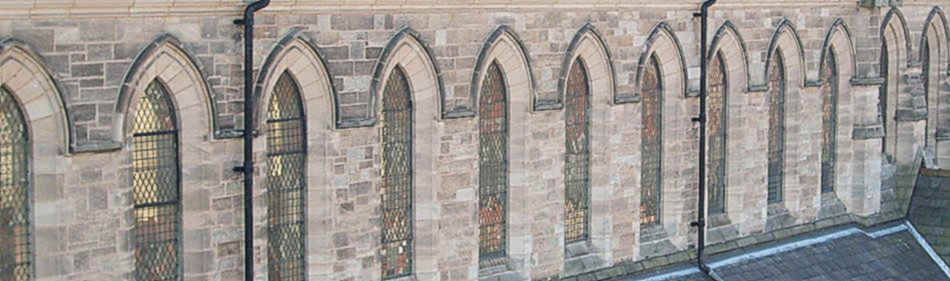
The architecture of the new building will be in an early English character. All superfluous ornamentation will be dispensed with, as the intention of the founders is to make the building as spacious as possible, due regard being had at the same time to dignity of style. It will be composed of a chancel, to which will be attached side chapels, sacristies and cloisters; a nave of six bays or sets of arches, with north and south aisles, and a tower, which, when completed, will reach a height of 200 feet, and will thus rival the highest towers and spires in the old city. The exigencies of the site have altered the customary positions of the chancel and tower. The former will be at the west end instead of the east; and the latter will hold the place that should belong to the former. The chancel, in which, of course, the high altar will stand, will be formed by a seven-sided apse. The roof, the height of which will be 72 feet, will extend from the apse throughout the nave. The width of the building is about 30 feet, the entire length 140 feet, divided thus: Chancel, 30 feet; nave, 80 ; and base of tower, 30. Sturton stone is the material to be used in the construction of the church by the contractor, Mr. T Hughes, of Alford. At present only the chancel, side chapels, and cloisters, with four bays of the nave will be built, the cost being estimated at upwards of £6,000. The remaining portion of the design, which includes a presbytery, or priest’s house, will be built afterwards. Mr. Edmund Kirby, of Derby Buildings, Fenwick-street, Liverpool, is the architect.
Shortly before twelve o’clock the children of the school walked in procession from the Dee House Convent, via the Grosvenor Park to the ground in Union-street, where the boys took up the position to the north and the girls to the south of the stone. Simultaneously with this a procession of priests was being formed to receive the Bishop on his arrival. His Lordship, who arrived about twelve o’clock, was attired in his Cappa Magna and Biretta, and was accompanied by his assistant Deacons, the Rev. J. Ross and the Rev. T. J. Marsden. His Lordship’s train-bearer was Master Nicholas Mostyn, the youngest son of Sir Piers Mostyn.
A procession was then formed and proceeded to the site of the church. It was preceded by a cross-bearer, who was followed by a numerous band of acolytes. After the acolytes came a body of clergy belonging to the diocese, the canons of the chapter, and the Bishop, who was accompanied by the bearers of his train, crozier, and mitre. Having taken his seat on a fald-stool placed near the foundation-stone, the ecclesiastics, who had meanwhile been joined by several Capuchin Fathers, formed themselves into a group around the Bishop, who began the ceremony by blessing the holy water intended for use in the benediction of the stone, the foundations, and walls. Salt was also blessed and mixed with the water, the name of the Holy Trinity being invoked in the process. His Lordship then solemnly blessed the place where the high altar of the church is to stand, and which was made known by the presence of a large cross. A choir, composed of clergymen, here sang Signum Salutus, “O, Lord Jesus Christ, put the sign of salvation in this place, and permit not the destroying angel to enter here.” Psalm 83rd, Quam dilecta Tabernacula Tua, was then sung, and at the conclusion of the recital the Bishop’s mitre was removed. His Lordship next offered up prayers prescribed in the ritual, and blessed the stone, the responses being given by the choir. He then sprinkled the stone with holy water, and marked on each side of it the sign of the cross, invoking at the same time the Blessing of the Father, Son and Holy Ghost. After another prayer the Litanies of the Saints were chanted, the mortar being in the meantime prepared for the reception of the stone. The antiphon, Mane surgens Jacob, “and Jacob, rising in the morning, set up a stone for a title, poured oil upon the top of it, and vowed a vow to the Lord: indeed this place is holy and I knew it not.” Psalm, 126, Nisi Dominus, “Unless the Lord build the house, they labour in vain that build it.” In order similar to that in which it entered the grounds, the procession walked to the place where the stone lay. Arrived there, the Bishop placed the stone as the foundation in the customary manner, calling for the blessing of the Holy Trinity. He aspersed with holy water the object of the ceremony, saying: “Thou shall sprinkle me, O Lord, with hyssop, and I shall be cleansed: Thou shalt wash me, and I shall be whiter than snow.” With his assistants he repeated Psalm 50th, Miserere mei Deus, and then walked round the foundations of the sacred edifice, which had been marked out, sprinkling them with holy water, while the choir gave forth the solemn strains of O, quam meteundus, “O, how terrible is this place, indeed this is no other than the House of God and the gate of Heaven.” Psalm 86, Fundamenta ejus was then recited, and his Lordship prayed to God to visit the place, driving away all demons, and sending his angel of peace. Pax aeterna, Bene fundata, est, and Psalm 123rd, Laetatus sum in his, were next chanted, and once more his Lordship delivered a prayer, asking God to give heavenly increase to His building; that what by his command was founded, by His bounty might be perfected through Christ. That act of worship was followed by the grand old hymn, Veni Creator, and the Bishop then stood up in presence of the assembled multitude and addressed them thus:-- I cannot allow this interesting occasion to pass away without reminding you of what has just been done and of what the church proposes to herself in the ceremony at which you have all assisted. This day is indeed one of great interest to many minds. St. Werburga herself will be filled with joy when looking on this scene to-day. It must needs be an exciting moment when the work of a new temple is begun to the honour of the living God, when the first step is taken towards the accomplishment of His loving purpose on behalf of those who will hereafter be gathered within these walls, and when you thus prepare the way for those good and holy things which in God’s own time we trust will here be multiplied abundantly, yea a thousandfold. To-day one more link has been added to that golden chain which unites Catholics of this time, in faith, and in worship with those who in the city of Chester glorified in the name of “Catholic” in ages gone by. You know full well that that venerable temple of God, the noble Cathedral of Chester, the pride and glory of the city, was founded as a truly Catholic temple. If you could go down to the foundations and look on the record they bear, you would find that it is precisely of the same character if not exactly in the same terms, as that of the building we are now founding. It is your happiness to feel that you have begun a work which shall rise beneath the shadow of the ancient religious temple of Chester and bear within it the same faith that dwelt in the old cathedral. In this sacred edifice will be dispensed the Holy Sacraments of the Church. Upon the head of the infant will be poured out the purifying stream of regeneration, rescuing it from the slavery of the devil; the holy chrism of confirmation will be bestowed upon the youth; the captive of sin will bring his burden of sorrow to God’s minister, and will receive freedom from him. The sacrament of marriage, too, will here be solemnised, and here also will the victim of priceless value, the atoning victim, Jesus Christ Himself, be daily offered up among His people, here He will abide among them.
A plenary indulgence of forty days was then granted by his lordship, who completed the functions of the ceremony by exhorting the people to give liberally of their means towards the consummation of the work that had that day begun.
The exhortation led to the contribution of many offerings of money, which were laid on the foundation-stone, about £150 being given in that way.
The deacon and sub-deacon assisting the Bishop were the Very Rev. Dean Ross and the Rev. Thomas Marsden. The Rev. E. Slaughter and the Rev. James O’Brien officiated as masters of ceremonies, and the cross-bearer was the Rev. Charles Cholmondeley. Among the clergy and laity present were the Very Rev. Canons Lennon, V. G. Pemberton, Chapman, Hilton, Buquet; the Rev. Dr. Marshall; Fathers Morris, S.J., Pacificus, Nicholas, Venantius; the Revds. R.A. Brundrit, P. Baron, R. M’Carte, J. Moore, F. Waterhouse, J.Robinson, T. Mulvaney, D. Williams, P. Power, H. Hopkins, E. Lynch, and G. Boen; Sir Piers Mostyn Bart., the Hon. Lady Mostyn, Miss Mostyn, Mrs. Stanley, Mrs. Brockholes, Mrs. John Hostage, Miss L. Hostage, Mr. G. Hostage, Mr. John Harnett, Mr. O. Harnett, Mr. Edmund Kirby, Mr. Joseph Kirby, Mrs. L. D. Kirby, Mrs. G. Dodsworth, Mr. Wheelhouse, Mrs. Wheelhouse, Mr. Summers, Mrs. Summers, Mr. and Mrs. Kelly, Mr. and Mrs. J. R. Topham, Miss Topham. &c.
Many of the clergy and laity who were present during the performance of the ceremony gathered in the Catholic Schoolroom, Queen-street, at two o’clock and there partook of a recherché luncheon provided by Messrs. Bolland. His Lordship the Bishop presided, and the vice-chairman was Canon Buquet.
The repast having concluded, His LORDSHIP, who was received with loud applause, asked them to join with him in an expression of affection towards one whose name, on occasions of that kind, was always placed at the head of the list. The toast was “Health and happiness to the Holy Father.” (Applause.) It was quite unnecessary, after all the better things had been said of him, for him (the Bishop) to declare in language their love of the Holy Father; indeed he would rather leave it to be felt inwardly than outwardly expressed. But if he was to express outwardly the feelings within he could say that their affection towards the Holy See was as deep and as unalterable as the Father on earth or in heaven could wish it to be. (Applause.) On all these occasions they stepped out of their insular position. They considered themselves members of the great community of the world, and, stepping into the world, they offered their love and dutiful attachment to him who was the head of the church. His Lordship concluded by formally proposing the toast, which was honoured with enthusiasm.
The Right Rev. CHAIRMAN next gave “The health of Her Majesty the Queen.” In doing so he remarked that a friend of his – a Catholic nobleman, who was well known to all present – made use of an expression that called forth various comments, some of which were not very favourable, whilst others were among those of commendation. He said, “I am a Catholic first and an Englishman next.” (Applause.) That expression he (the Right Rev. Chairman) most cordially approved and endorsed. (Renewed applause.) When they proposed the health of the “Holy Father” first, they spoke as members of a family larger than the circle of the island in which they lived. (Hear, hear,) but when they spoke of Her Majesty, they spoke as Englishmen and as subjects, than whom there were none more devoted or patient. (Applause.) So far from considering it open to objection, he thought it was an idea expressive of a higher conception of loyalty than that which usually prevailed. Next to Almighty God was the allegiance they owed their Sovereign. (Applause.) The sentiment he had given utterance to was common at all such meetings as the present one, but he was not sorry to repeat it. In fact, he thought it should be repeated as often as possible, because there were those who cast a slur upon a Catholic’s loyalty by calling it a divided loyalty. But it was only divided as between this world and the other, and surely no one could complain that they should give their allegiance to God first and their Sovereign next. The loyalty of the Catholic, however, to our gracious Queen was not a mere sentiment, but a duty taught him by his holy religion. (Applause.) It was not merely an allegiance of love, but an allegiance of duty. If he might be allowed to turn aside he would, in connection with the subject, make a few remarks concerning something that had been discussed much by the press of late, and that was the Confessional. They would be surprised, no doubt, to hear that subject referred to in a speech proposing the health of the Queen, but he would, in one word, point out to them wherein he considered the two questions, apparently so different, were not at all slightly but most intimately connected. Those who understood little about the Confessional – those who knew very little about its Divine institution, or of its Divine operation – were not aware that in reality the strongest safeguard of a Catholic’s loyalty to the Throne rested in the Confessional. The allegiance they owed to their sovereign was a religious duty. No one could be admitted to the benefits of the holy tribunal of penance who was guilty of a violation of the laws which were the commandments of God. The obedience they owed to the civil Government of the country was a duty impressed upon them by the Church of God. (Hear, hear.) So strongly did the Church feel that, and so strongly was her soul set upon it that no one could, as he had said, be admitted to the Sacraments who conspired, or was supposed to conspire against the civil Government of the country in which they lived. It was forbidden a priest to bestow any of the benefits of the Confessional on such offenders. All for instance belonging to secret societies were interdicted from those benefits because they were supposed to hold tenets and principles which in some way other were contrary to the laws of God and their country. No matter whether the society was that of the Fenians or Freemasons, its members were, so long as they belonged to it, excluded from the benefits of the tribunal of penance. That every Catholic might continue to hold allegiance to his Sovereign was the earnest wish of the pastors of the Church. (Applause.)
Mr. J KIRBY said that in dealing with the toast he had to propose he was happy to inform them they would have no occasion to leave their diocese, let alone their own island. Their lordship was present amongst them, and he called upon them, therefore, to return his lordship that love he had borne to them all. (Applause.) It gave him great pleasure to present on that occasion, and, as the honour had fallen upon him, he begged to propose the health of the Lord Bishop. (Applause.)
The toast was enthusiastically acknowledged.
The Right Reverend CHAIRMAN, in responding, said it was not so very long ago that he had the pleasure of meeting them in that same room on the occasion of the opening of the school, but he need hardly say that his pleasure was very much enhanced that day in beginning a greater work – a work that would be full of benefit to Catholics in the city – and he trusted they would all unite for the completion of the edifice they had that day begun. The want of another church was much felt, and the matter had been talked about for years, but now as they had begun in earnest they must all combine to push the work forward, for it was not a question of what the Bishop could do, or of what the congregation could do, but of what the Catholics in the district could do. (Hear, hear.) He trusted that his poor life would be spared until the completion of the church, and he need hardly say that he should welcome their invitation to that occasion. (Applause.)
The Rev. Father MORRIS said that he had been asked, putting his foot in Chester for the first time, to propose “Success to the New Church.” He regretted that he was unable to accompany his best wishes for the success of the church with any information concerning it, for he had come to learn and not to teach. But those who had resided with his lordship might go away with the feeling that he would not come to Chester for nothing, and if he might be allowed to do so he would congratulate his lordship upon the impressive and telling manner in which the ceremony of the morning had been performed. (Applause.) He would unite with the toast of “Success to the New Church” the name of its intended pastor, Canon Buquet. Although it was pleasing to them to see material churches, he might say that the church of Chester had existed for many a long day. (Applause.) It was quite possible for them to be turned out of their new church as they had been out of the old one, but the real church of Chester would live on through all ages. (Applause.) Referring again to the pastor, he said he had been told that in former times a pastor of the Chester church had been made a bishop, and he trusted that the same honour was in store for Canon Buquet. (Applause.)
The Rev. Canon BUQUET, having expressed his acknowledgement of the kind manner in which his name had been associated with the toast, proposed “The benefactors of the new church,” and in doing so expressed a fervent hope that they would be successful enough to build the church free of debt. (Hear, hear.)
The Rev. E. SLAUGHTER said it was rather hard that he should be called upon to respond to the toast of the benefactors, for there were none in the room to whom the name benefactor did not apply. This was only the beginning of the work, but they must look forward to the end, because it was the end that crowned the whole work. (Applause.) He hoped to meet them again when the church was completed, and he trusted that on that day they would all feel they deserved to have their health proposed. (Applause.)
The Rev. C CHOLMONDELEY, in highly eulogistic terms, proposed, “The Ladies and Gentlemen who have been invited to attend at the laying of the foundation stone,” coupling it with the name of his honoured friend, the Rev. Dr. Marshall, who, he said, possessed the reputation of being one of the most powerful orators in the country. (Applause.)
Dr. MARSHALL having responded in a humorous speech, the proceedings terminated with “The health of the Architect.”
We are informed that the sum received from benefactions of the faithful and other sources during the day amounted to £170.
Click here for a PDF of the page of The Cheshire Oberver in which this article appeared