St Werburgh's Catholic Parish, Chester
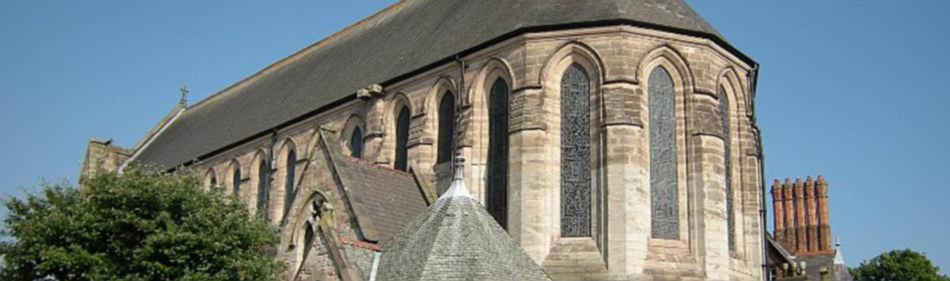
St Werburgh’s Church – Official Opening Ceremony 1876
In 1975, Sister Mary Winefride Sturman, OSU, having been commissioned by Canon Murphy wrote her book, Catholicism in Chester · A Double Centenary · 1875-1975 to mark the centenary of the opening of both St Werburgh’s and St Francis Churches.
In Chapter 2, referring to St Werburgh’s she wrote “The foundation stone of the new church was laid on October 15th, 1873, and through the hard work of the contractor, Mr. Hughes of Aldford, it was ready for use by the end of 1875. It was on Christmas Day, 1875, that the first Mass was celebrated by Cardinal Manning. No details of the occasion seem to have survived, and the Parish Notice Book for this year is missing.”
The opportunity has been taken to verify the above statements. St Werburgh’s baptism registers are now available digitally on the internet using Find My Past. These provide some verification as to the timing of the use of the new St Werburgh’s Church for religious functions. The entry for Gallagher, dated 19 December 1875, indicates this was the last baptism in Queen Street Chapel, Chester. The next entry for Reynolds, 23 January 1876, states, the first baptism St Werburgh’s Church Grosvenor Park Road, Chester.
![[Manuscript entries in baptism register]](/media/j2upcyns/opening_1.png?rmode=max&width=500)
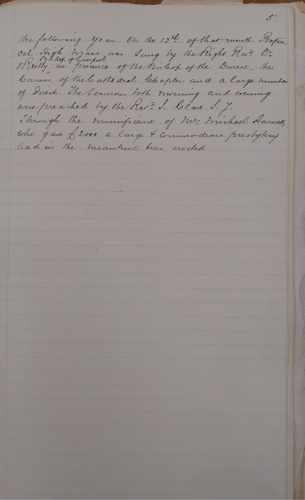
This evidence clearly shows the building of the new Church to be sufficiently advanced to be used for a baptism in January 1876. A study of Chester newspaper reports for this period makes no mention as to the completion of the church. It is possible that the Church was open and used for the Christmas services in 1875 but no contemporary reports of this have been found. One source, believed to be the notes of Canon Chambers, written circa 1902, held by the Diocesan Archives, confirms the Church was open for Mass on Christmas Day 1875. Canon Chambers took a great interest in early Catholic presence in Chester and from his notes it is obvious he had questioned parishioners and other clergy as to the remembered history of the Church in Chester. Copies of his notes which collated the priests who had served the mission and information as to the building and opening of the new Church have been attached as an Addendum.
The statement that Cardinal Manning celebrated the first mass on Christmas Day is not believed to be correct, most likely a proof reading error of the manuscript. Cardinal Manning had come to Chester 29 April 1875 to attend the official opening of the newly erected St Francis Church in Grosvenor Street, Chester, and preside over the festive lunch for 200 guests which was held at the Grosvenor Hotel to celebrate the occasion. The Daily News, London, 27 December 1875, states that Cardinal Manning celebrated the Christmas Day Pontifical High Mass at the Pro-Cathedral, Kensington.
The efforts of the contractor and the architect to complete the structure of the new church for use by Christmas 1875 were remarkable. Building work would have continued on the site during 1876 as Mrs Michael Harnett has generously given a further £2,000 to permit the building of a new commodious presbytery, thus enabling the Queen Street Chapel to be converted to use as additional school premises.
The Church was prepared ready for its official opening on July 12 1876. A surprising aspect of this was that the advertisement on Page 8 Column 1 of the Chester Courant described the event as the Opening of the St Werburgh’s Roman Catholic Cathedral.
![[Extract from old newspaper]](/media/fjibhqnz/opening_2.png?rmode=max&height=500)
The newspaper report of the official opening is given below.
Opening of a Roman Catholic Church at Chester
On Thursday the Roman Catholic Church of St Werburgh, Chester, was formally opened for the performance of religious worship, with elaborate ceremonial. The Church is a very handsome one, situated adjoining the Grosvenor Park, and has occupied about four years in erection. The style of architecture is somewhat nondescript, but the general effect of the building is pretty. The exterior is of grey stone, with a high gabled roof, and the interior consists of a nave and side aisles, divided by massive pillars of sandstone, the ceiling being stained wood, and the walls covered in white plaster. The altar is an elaborate structure, and when covered with a profusion of flowers, as it was on Thursday, looks very beautiful. There are in the interior of the church several beautiful paintings of different stages of the Crucifixion and other subjects. The seats will accommodate about 300 hundred persons, are open and of pitch pine, varnished.
The opening service commenced at 11 o’clock with Pontifical High Mass, the celebration of which in Chester, took place 300 years ago, and which on the present occasion, had the authority of the Holy See. The music was that of Hayden’s No. 1 Mass, which was beautifully rendered by a select band of 15 performers and about 20 vocalists. The celebrant was the Bishop of Liverpool (Dr O’Reilly), whose attendants were Fathers Clarkson, Leach, and Byrne, and Fathers Ross, Allen, and O’Brien were in attendance on the Bishop of Shrewsbury (Dr. Browne). Among the canons present were Provost Hall, and canons Fritty, Chapmen, Hilton (Vicar General), Buquet, Clegg, Cholmondeley, Walker, Carroll, Daley, and Shee. There were also a large number of priests taking part in the service, including the Rev’s M’Carten, Barrow, Power, Stanton, Robinson, Williams, J. Daley, Dallow, Burke, Greaney, Rogerson, B. Deary, Mulvanny, T. G. Marsden, and E. Slaughter (master of ceremonies).
The preacher was the Rev. Father Clare, S.J., who based his discourse on Psalm lxxxiv., 1 and 2 –“ How amiable are thy tabernacles, O Lord of Hosts. My soul longeth, yea even fainteth for the courts of the Lord; my heart and my flesh crieth out for the living God.” In the course of a long and eloquent address the rev. preacher endeavoured to show that if the temples of which the Psalmist sang in such glowing words were beautiful, the temple of the indwelling of Christ in His Church and people was still more beautiful, because in Him they had the embodiment of all that was infinitely lovely and infinitely beautiful. And this temple was not only beautiful because of the presence of Christ there, but because of what took place in that church. To it the Christian resorted in all his troubles, and there alone he found strength to undertake the conflicts and battles of life, and obtained a glimpse of that glorious temple to which he looked forward and as his reward and abode hereafter.
An offertory was taken at the conclusion of the celebration, and the service was brought to a close by the singing of the Hallelujah Chorus.
The band and the chorus were provided through the liberality and kindness of Mr T. Wallington, of Latchford.
A similar service was held in the evening, when Father Clare again preached, and special services will also be held on Sunday.
The congregations at Thursday’s services were not very large, owing probably to the somewhat heavy prices charged for admission. [1]
St Francis Church and St Werburgh’s Church were both opened in 1875. The official opening of St Francis Church in May 1875, describes a church with many of its internal fitments, statues, an organ, etc. already in place. The event had been long planned, Cardinal Manning, dignitaries from the Franciscan Order, Civic Leaders including the Earl of Denbigh, Sir Piers Mostyn were in attendance. At the luncheon held at the Grosvenor Hotel, 200 ladies and gentlemen sat down. The Mayor of Chester was also present though not in his official role. St Werburgh’s official opening in 1876 was by comparison a much more modest affair. There were large debts to the Banks on both churches and significant additional debt at St Werburgh’s entailed from the conversion of the old presbytery and Chapel in Queen Street to provide additional schooling accommodation for the girls and a caretaker’s house. The finances at St Werburgh were in a much more perilous state. The Church structure was incomplete due to a lack of available finance. A temporary wall had been built at the entrance of the church which was to remain in place for a further 40 years. Except for the seating and wooden tables used as altars there were very few adornments to the church we see today. It was not until 1936 that the Church was finally complete and debt free. It is not therefore surprising that the celebrations of the official opening of the church were on a lesser scale than those of St Francis. At the laying of the foundation stone of St Werburgh Church in 1873 it was recognised that the Church that was being built would be incomplete. The optimism of the early sponsors that this would only be a temporary state, proved to be wrong, the task was herculean, and far greater than was understood. To their great credit, the early mission rectors struggled to pay off the debt, to complete the church, running their parish, and building new schools. This work was undertaken whilst also engaging in the wider life of the city of Chester, supporting the Work House, the Infirmary etc.
John W. Curtis 2026
[1] Cheshire Observer 15 July 1875 Page 5 Col 5.
Addendum
![[Manuscript notes of Canon Chamv=bers]](/media/zmcccozt/opening_3.jpg?rmode=max&height=500)
![[Manuscript list of clergy names]](/media/nbqfptn2/opening_5.jpg?rmode=max&height=500)