
St Werburgh's Catholic Parish, Chester
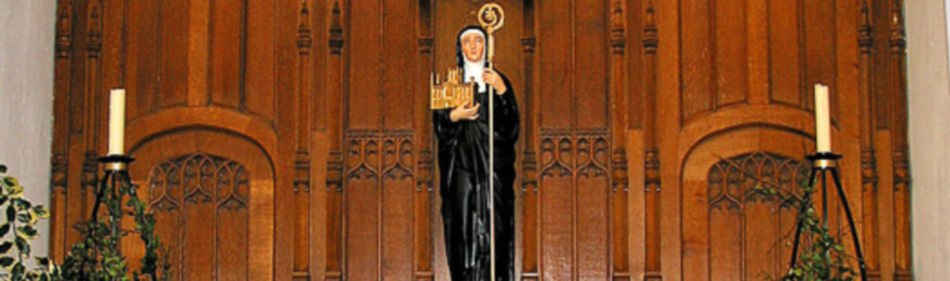
St Werburgh's Shrine
To tell the story of St Werburgh’s Shrine is to write part of the story of the development of St Werburgh’s Church over the last 150 years. In 1872, the architect’s plans for the Church showed that the area where the Shrine is located was the confessional for the early Church. In the March 1914 edition of the Parish magazine, 39 years after the Church was opened, Canon Chambers wrote on the Completion of the Church, “the roof is now on and the masons and bricklayers can now give their whole attention to the porch and the organ recess”. The confessional structure was removed and the external structure enlarged and repurposed to encase the 1882 church organ which had for many years been located at the entrance to the church.
![[Architectural drawing of Church]](/media/z5gn2qeo/architectural_drawing.jpg?rmode=max&width=500)
The organ remained in this location until 1927, when Canon Rooney and then later Canon Hayes were making major changes to the Church. The new High Altar had recently been installed and the organ was removed to the Sanctuary. The organ was split and the pipes were gilded with English gold leaf to enhance the appearance of the new Altar. Throughout this post-war period, when the internal furnishings of the Church were undertaken, the rector of St Werburgh’s, the Bishop and Edmund Bertram Kirby, the original architect’s son, maintained frequent contact. This ensured agreement on the changes proposed. Rectors, such as Canon Chambers, were well schooled in Church architecture and design, having been tutored by A. W. N. Pugin whilst at Oscott.
The removal of the organ created the space for inclusion of a Shrine to the Church Patron Saint, St Werburgh. The Shrine was one of the last remaining Church fixtures commissioned by Canon Hayes, completing the interior furnishings of the Church. The final design by E. Bertram Kirby was agreed and installed in 1931. Johnston, Jones & Co., Liverpool, were the contractors for the provision of the kneeler, inside framing and the Sanctuary itself. Edward Pritchard, 16 Canal Street, Chester, installed the panelling.
Great attention was paid to the detail design of the Statue by the Architect. Requests for quotations were obtained from Charles Beyaert, Ecclesiastical Art Studios, 6 Rue Notre Dame, Bruges. The contract was eventually awarded to a London firm. The St Werburgh statue was designed and carved by an unknown carver working for Art & Book Co. Ltd, London. The same carver was later commissioned to carve the Crucified Christ on the Great Cross installed in 1933. The Statue of St Werburgh in golden pine is 4ft 4in high and cost £30. Before his death, John Douglas, the Chester Architect who designed the Victorian Area of Chester, had decided make a donation of £20 to Edmund Kirby for a statue of St Werburgh to be placed in the Church. When Edmund Kirby had first practised as an Architect in the 1860s, he had worked briefly for John Douglas, and they remained friends afterwards. When the architect’s son was designing the Shrine, he indicated that he already had the money for the statue.
![[Shrine of St Werburgh]](/media/zivbsmoc/shrine.jpg?rmode=max&height=500)
![[Statue of St Werburgh]](/media/qlal0ric/weburgh_statue.jpg?rmode=max&height=500)
The stained glass window behind the Shrine is by Trena Cox, a premier lady stained glass artist. She was employed by Williams, Gamon & Co, Kaleyards (Ltd), Chester. The Pilgrims sign in the window reflects the original one in the British Museum. Replicas were given to pilgrims to the shrine in the Middle Ages, and are still sold in Chester Cathedral today. Trena Cox, describing the window, writes "the sign represents 5 geese in a basket". It refers to the story of how some wild geese were caught and killed by a convent cook and baked into pies. Other geese came fluttering around St Werburgh all day until she realised something was wrong. Finding out the cause, she restored the dead birds to life again by a miracle. The window was installed in 1931 at a cost of £12.
![[Stained glass window]](/media/1942/pelican.jpg?rmode=max&height=500)
Trena Cox appears to have had a fraught relationship with Canon Hayes. In June 1936, Canon Hayes wrote to the architect, “Miss Cox has an order to fill all the Porch windows with stained glass - £145. I have had fierce fights with her. The poor heretic lady artist is further away from the Church than ever. She has a very great admiration for our Bishop and for you, so if she is ever converted, one of you must receive her into the Church.”
This was not the complete story of the Shrine. In 2004, there was a reordering of the church interior and the installation of the refurbished James Jepson Binns Organ above the porch. The Shrine was again modified, this time to permit the installation of an organ Blower and the Choir section of the new organ, behind the Shrine.
![[Organ components in front of shrine panelling]](/media/1765/230.jpg?rmode=max&height=500)
![[Crib in front of shrine]](/media/1687/st_werburgh_s_crib_and_shrine_2004.jpg?rmode=max&height=500)
![[Shrine with poster board showing goose]](/media/cctbeucu/shrine_feast2026.jpg?rmode=max&height=500)
Werburgh Wulfhere
Werburgh, born ~650, was the daughter of the King of Mercia, a kingdom that had only recently converted to Christianity. Werburgh was initially trained at home by Chad (Bishop of the Mercians) [i]. Chad had been a student of Aidan at the Celtic Monastery at Lindisfarne. This was the time when both Celtic and Roman clergy were converting England to Christianity. She entered the Abbey of Ely where she was trained by her great-aunt, the first Abbess of Ely and her grandmother. Werburgh was instrumental in convent reforms across England. She succeeded her mother Ermenilda, her grandmother Seaxburh, and great-aunt Etheldreda as fourth Abbess of Ely. She died on 3 February 700 and was buried at Hanbury in Staffordshire.
Following Werburgh's death, her brother Coenred became King of Mercia. In 708 he decided to move his sister's remains to a more conspicuous place within the church at Hanbury. When the tomb was opened, her body was found to be miraculously intact. This preservation was taken as a sign of divine favour. A year later Coenred had abdicated as king and taken holy orders, becoming a monk in Rome. It was at this time that the most famous story about Werburgh appeared, according to which she restored a dead goose to life, as recounted by the medieval hagiographer Goscelin.
The shrine of St Werburgh remained at Hanbury until the threat from Danish Viking raids in the late 9th century prompted their relocation to within the walled city of Chester. A shrine to St Werburgh was established at the Church of St Peter and St Paul (the site is now occupied by Chester Cathedral).
In 1540 the dissolution of the abbey led to the creation of Chester Cathedral, which was rededicated to Christ and the Blessed Virgin Mary. Although an elaborate shrine had been constructed in the 14th century to Werburgh, this was broken up at the time of the Dissolution. Werburgh's relics were lost. Parts of the shrine's stonework that survived were reassembled in 1876. The shrine remains on display in the cathedral's Lady Chapel at the back of the main nave. [ii]