St Werburgh's Catholic Parish, Chester
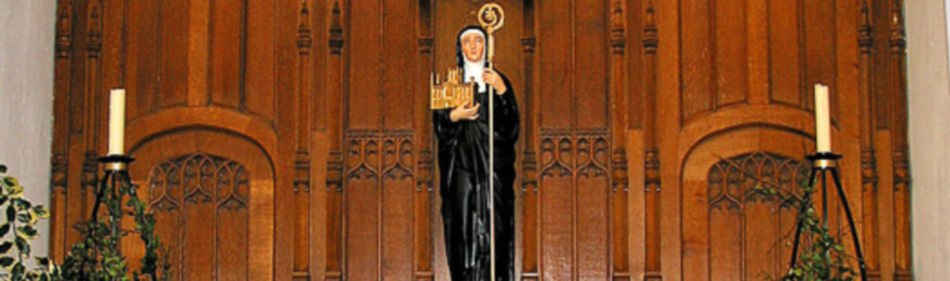
St Werburgh and her Shrine
By W. Dallow – Rector St Werburgh Chester, 1882-83
This article appeared in St Werburgh Parish Magazine February 1917. It describes the life of St Werburgh and her shrine in Chester Cathedral.
St Werburgh was a most distinguished Lady in Mercia in the Seventh Century , being born in the part of the “Midlands,” now called Staffordshire, at the town of Stone. She was the daughter of King Wulfere, her Grandmother (St Erminilda), her Mother (St Sexburga), and her Aunt (St Ethelreda), were all illustrious for their beauty and virtues. When very young she entered the famous Convent of Ely, which enjoyed the unique privilege of having for its first three abbesses of the Order of St Benedict, in the aforesaid ladies, a Queen of Northumbria, a Queen of Kent, and a Queen of Mercia.
Allured by her many attractions of mind and body, a rough Saxon noble called Werbode sought her hand in marriage, but, to his disgust, Werburgh could not be moved from her holy intention of entering the cloister. Her father also threw in his influence to force upon his only daughter so suitable a match, but all to no purpose. Imagining that her two brothers – Wulhad and Ruffin – who had been recently baptised by St Chad, first Bishop of Lichfield, were upholding her in her design, the wicked suitor, by connivance of their own father, slew them both in a fit of passion. The great pile of stones which, according to the custom of those days, was raised on the site of their martyrdom, gave the name of Stone to the town which sprang up there afterwards.
The King, now struck with remorse at his crime, strenuously laboured to extirpate idolatry from his dominion, and by way of reparation built a Priory at Stone, and at Medehamsted, the modern Peterborough. The reception of St Werburgh as a nun, at the great Abbey at Ely, was made an affair of great pomp. The Royal maiden was escorted thither by her father and a large company of Saxon Nobles, including Egbert, King of Kent, and Adulph, King of the East Angles, and she was met at the gate by her aunt, the Royal Abbess St Ethelreda, who had received the veil from St Wilfrid, Bishop of York.
Here, Werburgh put aside her jewels and rich apparel, and received the black coarse habit of St Benedict. She devoted herself straightway to a life of prayer and mortification. After the death of Wulfere, in 675, Ethelred, her uncle, who succeeded to the throne, implored of our Saint to leave the Abbey of Ely, and take charge of all the religious houses in his kingdom of Mercia, that thus they might be brought by her pious influence under one rule of exact discipline. St Werburgh consented, and founded, by his munificence, the famous Convent of Trentham and Hanbury, in Staffordshire, and of Weedon in Northamptonshire.
(Ethelred having exchanged the crown for the cowl, ended his days as a Saint in the Monastery of Bardney, and was succeeded by his nephew Kendred, who, not to be outdone in piety, founded the Collegiate Church of St John the Baptist, on the banks of Dee, outside the walls of Chester. This latter fact may perhaps, account for the reason why the body of his sister, was afterwards translated to Chester, a place never visited by her during her life, but which was destined to honour her as its patroness, and possess her shrine as a precious deposit). Thus did St Werburgh become the spiritual mother of innumerable virgins, yet so far was she from being elated by her dignity, that she never forgot her own duties as a religious. Her chronicler tells us that she recited on her knees daily the entire Psalter of David, viz 150 Psalms; that she remained in the Church, from midnight office until daybreak, bathed in tears, amd she allowed herself but one meal each day.
After a life of good works she calmly foretold her death, then made all her preparations and gave final orders with the same regularity which had marked her whole career. She gave up soul to God in her Abbey at Trentham on the 3rd January, 692. The people of the neighbourhood, by a custom not uncommon in those days, fought for the possession of her body, but according to her dying wish it was buried at the Abbey of Heanburgh, or Hanbury. Nine years after, in 701,the body was taken up in the presence of King Kendred and many Bishops. It was incorrupt, and was now placed in a new and costly shrine.
In 875 the Danes were making encroachments in the neighbourhood, and therefore for greater safety her sacred remains were solemnly conveyed to Chester where Ethelred, son-in-law of Alfred the Great, rebuilt the Church of St Peter and Paul, and endowed the edifice in honour of St Werburgh (which afterwards became the Cathedral), placing there a College of secular Canons. In the reign of Edward the Confessor the Church was built in a yet more sumptuous manner by Leofric and Godiva. Hugh Lupus, First Earl of Chester, removed the above Canons and placed instead Benedictine Monks from the Abbey of Bec, in Normandy, over whom St Anselm (the future Archbishop of Canterbury) appointed his own Chaplain, Richard the first Abbot of Chester. The long line of Abbots continues unbroken to John Clarke, the 27th, when at the dissolution of religious houses by Henry VIII, the last Abbot became the first Dean. William of Bebington (1345-9) was the first Abbot who sat in Parliament, a privilege enjoyed by a limited number only of Monasteries in the Kingdom.
We come now to speak of the Shrine of St Werburgh. It is not known exactly when or by whom this shrine or more correctly the stone monument which held the shrine or casket, was erected. From its beauty and elaborate workmanship, its date is placed in the reign of Edward II, when Gothic art was at its zenith. In the “Ages of Faith,” men worked solely for God’s glory.
This shrine was erected by the present Dean Darby in 1889.
About 8ft high, it consists of two storeys. The carving and the statues are beautiful and delicate. We hope that all who can do so will visit the shrine itself and say a prayer for the return of the ancient Faith to Chester, and England. Its original position is not certain. It is one of the very few shrines spared by the Huns of the Reformation.
When the Tudor Tyrant made the first Bishop of Chester, the stone shrine of the Patron Saint of the City became the Episcopal throne, and from henceforth dates its various changes and mutilations. The bones of St Werburgh probably shared the common fates of our English Saints, viz, they were buried secretly by the Benedictine monks, or if such precautions were neglected, they were cast out profanely, and the rich casket became the prey of the sacrilegious Henry.
Alban Butler, in her life, alludes to one special prodigy, when her silver shrine, borne in solemn procession through the town, is said to have extinguished the great fire among the wooden houses, of which the streets were in those times composed. She appears on the Abbey seal.
In all England there are now only two Catholic churches dedicated to her, namely, in Chester and Birkenhead. Strangely enough an ancient church in Dublin built by Chester immigrants in the middle ages also bears her name.
Let us hope that Catholic pilgrims will come to her shrine, and implore her prayers for the final undoing of the Reformation.
Canon Chambers' Notes continued,
We are pleased to announce that the Feast of St. Werburgh (February 3rd) has been extended to the whole of this Diocese of Shrewsbury. Beyond the two Churches that bear her name the Feast will be observed in all Churches and Chapels of the Diocese that are under the care of secular clergy, or that have not a calendar of their own. In the Churches of St Werburgh at Birkenhead and Chester the Feast is of the Highest Order, i.e., Double of the First Class with an Octave.
- Double First Class: This was the top rank of feast days, reserved for the most important celebrations such as Christmas, Easter, Pentecost, Epiphany, Corpus Christi, and certain Marian feasts. These days had the most solemn liturgy, with no other feast able to outrank or replace them.
- With an Octave: An octave is an eight-day period of celebration, beginning on the feast day itself and continuing until the same day of the following week. For a Double First Class feast, the octave was often privileged, meaning that the feast’s liturgical texts and themes dominated the entire week, even if other saints’ days occurred during it.