St Werburgh's Catholic Parish, Chester
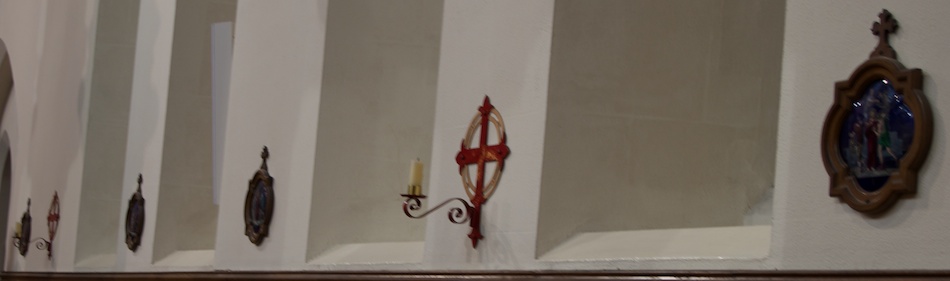
St Werburgh's Stations of the Cross
Stations of the Cross were a way of imitating the early pilgrims to the Holy Land. These people visited shrines, and recognised Holy Places as part of their pilgrimage. When Jerusalem fell to the Muslims in 1187, these pilgimages ceased. Forty years later the Franciscans were allowed back into the Holy Land. For their efforts the Franciscans were officially proclaimed the Custodians of the Holy Places by Pope Clement VI in 1342. It was an English pilgrim, William Wey, who visited the Holy Land in the mid-15th century, who is credited with the use of the word “Stations” to decribe the halting places of pilgrims following the footsteps of Christ to the Cross. As many could not visit the Holy Land, over time the practice of erecting Stations of the Cross as an outdoor shrine began. The number of such stations ranged from seven to thirty. In 1731, Pope Clement XII extended to all churches the right to have stations, provided that the Stations were erected by a Franciscan Father. At the same time the number of stations within a church was fixed at fourteen. In 1857, the Bishops in England were allowed to erect the stations by themselves, without the intervention of a Franciscan priest, and in 1862 this right was extended to Bishops throughout the church.
The fourteen Stations of the Cross depict the following scenes:
- Pilate condemns Jesus to die
- Jesus accepts his cross
- Jesus falls for the first time
- Jesus meets his mother, Mary
- Simon of Cyrene helps carry the cross
- Veronica wipes the face of Jesus
- Jesus falls for the second time
- Jesus meets the women of Jerusalem
- Jesus falls for the third time
- Jesus is stripped of his clothes
- Jesus is nailed to the cross
- Jesus dies on the cross
- Jesus is taken down from the cross
- Jesus is placed in the tomb
St Winefride’s Neston, an Augustin Welby Pugin Church opened in 1843, has a near identical set of Stations of the Cross to St Werburgh’s. The St Winefride website provides the following information on their Stations of the Cross. ‘The Stations of the Cross were added 1923 - 1925, the depth of colouring in the enamels complementing the stained glass. These enamels were executed at the end of the nineteenth century, or early twentieth and are derived, as far as shape and mood are concerned, from those in the workshop of Leonard Limosin at Limoges in the sixteenth century. Maison Bouasse Lebel Lecere & Co., Paris and Hardmans, Birmingham were the suppliers. Each station bears the name(s) of a donor many of whom or their families are buried in the churchyard.’
The Limoges design of the Stations of the Cross is believed to have been used for a number of other churches, Église Saint-Étienne, Wignehies, France, the Church of Our Lady of the Sepulchre and St Stephen, New York, and St Mary's Catholic Church, Ipswich, Queensland, as well as St. Werburgh’s and St. Winefride’s.
If one compares St Werburgh’s Church Stations of the Cross with those of St Winefride’s Church, Neston, then the great similarity between the two sets is apparent. An example to show this is no. 12, Jesus dies on the Cross. They are obviously constructed using the same cartoon. No two sets of stations are identical as the cloisonné enamel images are formed by hand before the enamel is fired.
![[Enamel station no. 12, St Werburgh's]](/media/5vlh3h2y/station12_werburgh.jpg?rmode=max&height=500)
![Enamel station 12, St Winefride's]](/media/3ysn3bih/station12_winefride.png?rmode=max&height=500)
Edmund Bertram Kirby was managing Kirby Architect’s in the 1920s following his father’s death. He retained close links with Canon Chambers during this period, arranging the purchase and installations of many of the items necessary to furnish the Church interior. His brother, Edmund Francis, was also associated with the business. Coincidentally, Edmund Francis had gone to live in Parkgate before the Great War and attended St Winefride’s Church in the neighbouring village of Neston, less than a mile distant from his home. (He is buried in St Winefride’s graveyard.) It is possible therefore that both sets of Stations of the Cross were ordered by Kirby’s from Hardman’s during this period.
St Werburgh’s cloisonné enamel Stations of the Cross took two years to produce at Limoges in France and were installed in 1929. Maison Bouasse Lebel Leclere & Co., Paris and Hardmans, Birmingham were the suppliers. They replaced a set of wooden stations that had been used previously. Fr Hayes' authorisation for the Stations of the Cross from the Franciscans is shown in the photo below. July 1929.
![[Certificate of authorisation]](/media/yofntsyp/stations_authorization.jpg?rmode=max&width=500)
![[Detail of certificate]](/media/qt0dg0bs/stations_authorization_detail.jpg?rmode=max&width=500)
No report has been found of the purchase nor list of any donors for the Stations of the Cross. During the Second World War, Canon Hayes, the Rector, was so concerned of aerial attack on Chester that he had the precious enamel Stations of the Cross removed for safe keeping and a set of wooden stations put in their place. These wooden crosses are still retained and in 2015 Fr Paul Shaw had them displayed alongside the enamel stations. In 2017, as part of the Great War Commemorations, the Church saw three sets of Stations on the walls of the Church. This occurred when a set of wartime paintings of the stations by Thomas Burke, a Liverpool artist with connections to a family in the parish, were displayed at the same time. More recently, in 2025, some display stands were acquired that permitted the Wooden Stations to be located in the window arch adjacent to the cloisonné enamel stations.
![[Wooden station no. 8]](/media/njtfypyp/station8_wood.jpg?rmode=max&height=500)
The purchase date of these wooden crosses is not known. It is possible that these are the original Stations of the Cross put up in the Church soon after it was built. They may be even older and have been used previously in the Queen Street Chapel.