
St Werburgh's Catholic Parish, Chester
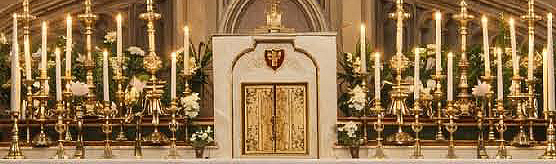
The new High Altar (1926)
In many of his articles in the parish magazine from 1904 to 1917, Canon Chambers had lamented the fact that the high altar was a wooden trestle table covered with white cloth. Arthur Brandreth, a great benefactor of St Werburgh’s Church who died in the Great War in 1916, had left £450 for a High Altar and Baldequin. He had stipulated in his will that the design of Benedict Williamson should be used. Sadly, no money was released for this use by the will’s trustees.
When Canon Chambers died in 1924 there was still no High Altar. Bequests left by Canon Chambers and Miss Margaret Collins, who had also recently died, were used to purchase the long-awaited High Altar and Altar Rails. The design of these items was undertaken by the architect Edmund Bertram Kirby, son of the original Church architect.
It was therefore not until 1926 when the Very Rev. Canon Eugene Rooney was Parish Priest that the High Altar and Altar Rails were finally erected by John Stubbs and Sons, Liverpool. On Wednesday evening, the vigil of the relics was kept before the relics were placed in the altar. The following morning, Thursday 25 November, the Bishop of Shrewsbury conducted the service of consecration of the new altar. The choir of Priests sang the seven Penitential Psalms, and then followed the procession, bringing the relics of the Saints to lay on the altar; the incensation of the relics of the Saints Cassius and Sebastian (Martyrs) came next, and then the blessing of the water for the lustration of the Altar, and finally the blessing of incense, fire, salt and wine with which the altar was washed. The following Sunday, the new High Altar was used for the Golden Jubilee Service of the opening of the Church.
![[The High Altar of St Werburgh's Church]](/media/kkrd42g5/highaltar.jpg?rmode=max&width=500)
The altar is composed of white Carrara statuary marble (Figure 1). The frontal is inlaid with a magnificent slab of red Algerian Onyx with an inch border of Belgian black marble. The horizontal treads of the lower Super-altar are of rich Sienna marble. The upper Super-altar, which is returned down the side so as to form a background to the whole altar, is composed of Blue Belge marble.
The screen at the rear is built of local red sandstone, the dominant members of which are gilt. The steps up to the altar have Mereuil risers and Dove marble treads. The floor of the Praedella is inlaid with a geometric pattern of the same materials.
The altar generally is designed with a view to emphasising the purpose for which it is erected, namely the sacrifice of the Mass. No ostensible provision is made for the accommodation of the Monstrance at Benediction. It can, however, be placed on the top of the screen under a detachable canopy to which access is obtained by steps at the rear.
The tabernacle is of white Statuary marble inlaid with bands of Cosmati glass mosaic in red, blue and gold. The Tabernacle doors are of silver plate.
![[Manufacturer's invoice]](/media/204gqcro/highaltar_invoice.jpg?rmode=max&height=500)
The altar, its fitments and the altar rails were all made by local Wirral or Liverpool craftsmen. The final cost of the manufacture and installation of the above are detailed in a letter from Edmund Kirby & Sons 18 February 1927 as £2682 17s 3d. The cost of the manufacture by John Stubbs & Sons was £1531 6s 3d (Figure 2), considerably more than that envisaged in the Arthur Brandreth bequest.
John W. Curtis 2025
Addendum: source materials
![[Newspaper cutting]](/media/evudgsme/chronicle_1.jpg?rmode=max&height=500)
![[Newspaper cutting]](/media/rljpbdp1/chronicle_2.jpg?rmode=max&height=500)
![[Typewritten description]](/media/eumnjnc3/altar_description.jpg?rmode=max&height=500)