St Werburgh's Catholic Parish, Chester
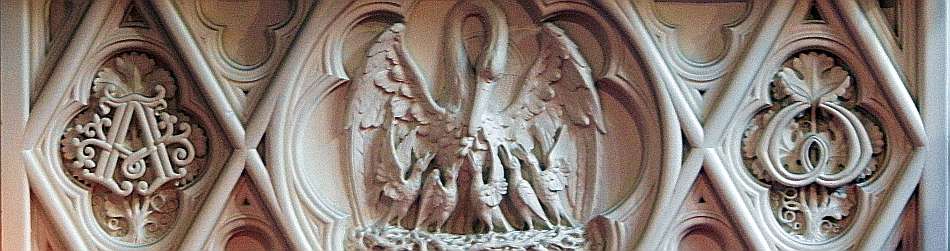
The Sacred Heart Altar
At the end of the 1890s, twenty-five years after St. Werburgh’s was constructed, the Church would have looked very different from today. The structural fabric of the Sanctuary, part of the main chancel and the new presbytery were completed, but the internal fitments were very basic. Pews had been purchased that are still in use to-day, but there was no electric lighting nor heating. The Altars were simple wooden tables covered in white cloth. Vestments, chalices etc. in daily use would be those brought from the original Queen Street mission. The church would have been very dark as the walls were of bare stone. The Sacred Heart Altar was the first permanent Altar designed by the Church Architect, Edmund Kirby.
The Sacred Heart Altar, together with the stained-glass windows to St Cecilia, St John, and St Dorothy, were donated by Miss Josephine Hall, in memory of her parents and sister. The inscription across the three windows reads: "For Love of the Sacred Heart, Pray for the souls of John, Alice and Cecile Hall to whose memory this window and altar are erected, AD 1900." The Altar was consecrated on 30th January 1901 [1]. The choice of saints for the windows reflects the names of the Hall family, Mr John Hall, Mrs Alice Dorothy Hall (nee Topham) and Miss Cecile Mary Topham Hall. These three members of the family died between October 1898 and April 1899.
The Sacred Heart Chapel windows



St Cecilia, St John and St Dorothy. The triptych of windows in the sanctuary, by the Sacred Heart Altar. The inscription across the three windows reads: "For Love of the Sacred Heart. Pray for the souls of // John, Alice and Cecile Hall // to whose memory this window and altar are erected. AD 1900."
The Sacred Heart Altar
The Sacred Heart Altar remained unchanged for 100 years, until in 2002 as part of the Church reordering and refurbishment, the Sacred Heart Statue was moved to a position between the Church exit doors beneath the organ loft. At this time wooden screens were erected hiding the original High Altar, and as a result the Reserved Sacrament was moved from the High Altar and placed in the Tabernacle on the Sacred Heart Altar. The Altar then became known as the Blessed Sacrament Altar.
![[Old organ console in fron of the Sacred Heart Altar]](/media/1537/old_organ_console.jpg?rmode=max&height=500)
The Blessed Sacrament Altar
![[Blessed Sacrament Altar]](/media/wjonmz4c/blessedsacramentaltar.jpg?rmode=max&width=350&height=366)
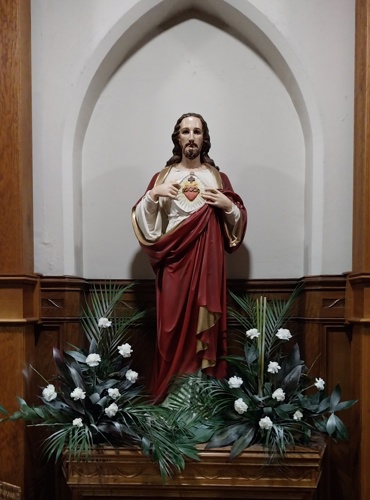
More recently it has been found that access to this beautiful statue is obscured by notice boards, tables. As a result, consideration is being given in 2026 to returning it to its original position.
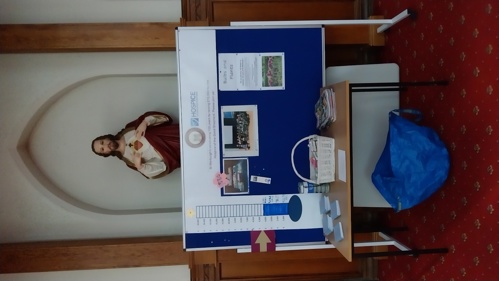
Addendum: Notes as to the sculptor, mason who produced the Sacred Heart Altar
No information has been located in Church files or newspapers as to the manufacturer of the Sacred Heart Altar.
Local Chester stone mason and sculptor, Edward Griffiths, with showrooms at 30 Grosvenor Road and a works at Crane Bank on Sealand Road, is a possible candidate. He undertook a great deal of work at Eaton Hall and was also responsible for the grotesque corbels on a part of the restoration of Chester Cathedral [2]. He left Chester in 1897 and amalgamated with Messrs Warings, 181 Oxford Street, London [3]. His son, Edward Owen Griffiths, worked with his father. Soon after his marriage in Chester, 7 September 1892, Edward Owen set up business in Liverpool to carry out the sculpture on the General Post office in Liverpool. Subsequently he was entrusted with work on most of the buildings and churches in Liverpool, including the Liver Building. The Kirby files in Liverpool Central Reference Library show that Edward Owen Griffiths produced a number of sculptures to E. B. Kirby Design. These include St Werburgh’s “Our Lady of Sorrows Altar” (War Memorial Altar), installed in 1923, including the Pieta, and the High Altar Rails installed in 1926/7. E. O. Griffiths were also paid £112 to move the Pulpit as part of the chancel refurbishment. He also undertook the work of carving the caps to the sandstone columns in the church.
Another employee of E. Griffiths, Patrick Honan, went with Edward Owen to Liverpool. He was a young Irish sculptor who had married Ann Pozzi at Bangor before moving to Chester. Whilst in Chester, Patrick was an active member of St Francis Parish. Early examples of his work were the two marble tablets placed in that Church in 1891 to the memory of the late Very Rev. Fathers Venantius and Pacificus who were considered the founders of the mission. The Cheshire Observer reported the tablets were the work of a promising young Catholic sculptor of this city [4].
Patrick Honan’s work made him famous as a sculptor. He was one of the sculptors and modellers for Liverpool Anglican Cathedral. He was a frequent exhibitor at the Autumn Exhibition at the Walker Art Gallery and he produced busts of Mr Henry Gladstone and Mgr Gradwell. Some of his work embellishes the General Post Office and his work is to be seen in numerous Liverpool buildings and churches. He executed a good deal of the carving at the Chapter House and on the Bishop’s throne, as well as a number of the figures, at the Anglican Cathedral. When he died in 1930, a Requiem Mass was offered at Our Lady Immaculate Church, Everton, and he was interred at the Franciscan Monastery at Pantasaph. Fr Austin Owen Pozzi, a nephew, officiated at the graveside. Fr. Pozzi was the Rector of the St Anthony of Padua Church, Saltney, when the new Church was opened in November 1914. The Franciscans who had previously served there handed the parish over to the Bishop of Menevia in 1913.
Edward Owen Griffiths, together with Patrick Honan, the location of the business in Liverpool, and the proximity to Edmund Kirby offices makes Edward Owen Griffiths company a strong candidate for the manufacture of the Altar.
A possible alternative supplier of the Sacred Heart Altar is the firm R. L. Boulton and Sons, the country’s leading ecclesiastical sculptors based in Cheltenham. This company had an astonishing output of statues, altar-pieces, pulpits and other church furnishings. Press reports in 1900 of the Jubilee Celebrations of St Francis Church, Chester, reported the service of dedication of the Altar and Pulpit erected by the Cheltenham Firm (R. L. Boulter not actually named). The new Altar was erected to the memory of the Tatlock family. By his will, Canon Tatlock, who died in 1899, had paid off the parish debt of £3,750 on St Werburgh’s and the £3,000 still owing on St Francis. The Bishop was present for the occasion with the Very Rev. Canon Lynch, St Werburgh’s, acting as one of his Deacons [5]. There were close links between the two Chester churches. We could speculate that the Cheltenham firm was entrusted with the provision of the two Altars erected in Catholic Churches in Chester in 1900/1.
The Sacred Heart Statue, in its size and quality, is very similar to the two statues of St Joseph the Carpenter and the Madonna and Child located at the front of the Sanctuary. A letter dated 16 June 1932 shows that these two statues, executed in Caen stone, were purchased from the firm R. L. Boulter & Sons, Bath Road, Cheltenham. The order for these two statues was made by Hardman’s of Birmingham who were used to produce the stained glass windows in the nave.
[1] Irish News and Belfast Morning News, 21 Feb 1901 Page 6 Col 5
[2] Cheshire Observer, 24 Oct 1931 Page 9 Col 4
[3] Chester Courant, 13 Jan 1897 Page 4 Col 7
[4] Cheshire Observer, 21 Apr 1891 Page 5 Col 2
[5] Crewe Chronicle, 16 June 1900 Page 2 Col 6
John W. Curtis 2025